Citation M2 & CJ1 Garmin
Avionics Upgrade
Glass cockpit upgrades for the entire Citation 525 family — CJ1, CJ1+, M2, and M2 Gen2. G3000 NXi upgrades, full Garmin retrofits, and G600 TXi conversions. FAA Certified Repair Station, Sebastian, Florida.
We’ve Done This — Here’s What We Learned
Most shops listing Citation Garmin upgrades are reselling Garmin’s marketing copy. We’re not. We’ve completed multiple Citation Citation glass cockpit conversions — and we know exactly what it takes because we’ve had our hands inside the wire bundles, fabricated the panels, wrestled with the integration, and flight tested the finished aircraft.
The Citation 525 is not a straightforward platform to retrofit. The original Collins Pro Line 21 system is deeply embedded in the airframe. Behind that instrument panel sits a dense maze of legacy wiring — decades-old harnesses routed through tight channels that weren’t designed with aftermarket Garmin equipment in mind. Pulling the old system and replacing it with a full Garmin suite means custom-fabricating every wiring harness from scratch, redesigning the panel layout for the new display cutouts, and solving integration problems that only show up when you’re knee-deep in the actual airplane.
That’s the difference between reading a Garmin STC supplement and having done the work. We know where the Citation 525’s wire bundles route. We know which legacy relays need to be addressed for the GFC 600 servo installation. We know how to route the TXi EIS harness to the Williams FJ44-1AP engine sensors without interfering with the existing fire detection loops. These aren’t things you find in a brochure — they come from hands-on experience with the airframe.
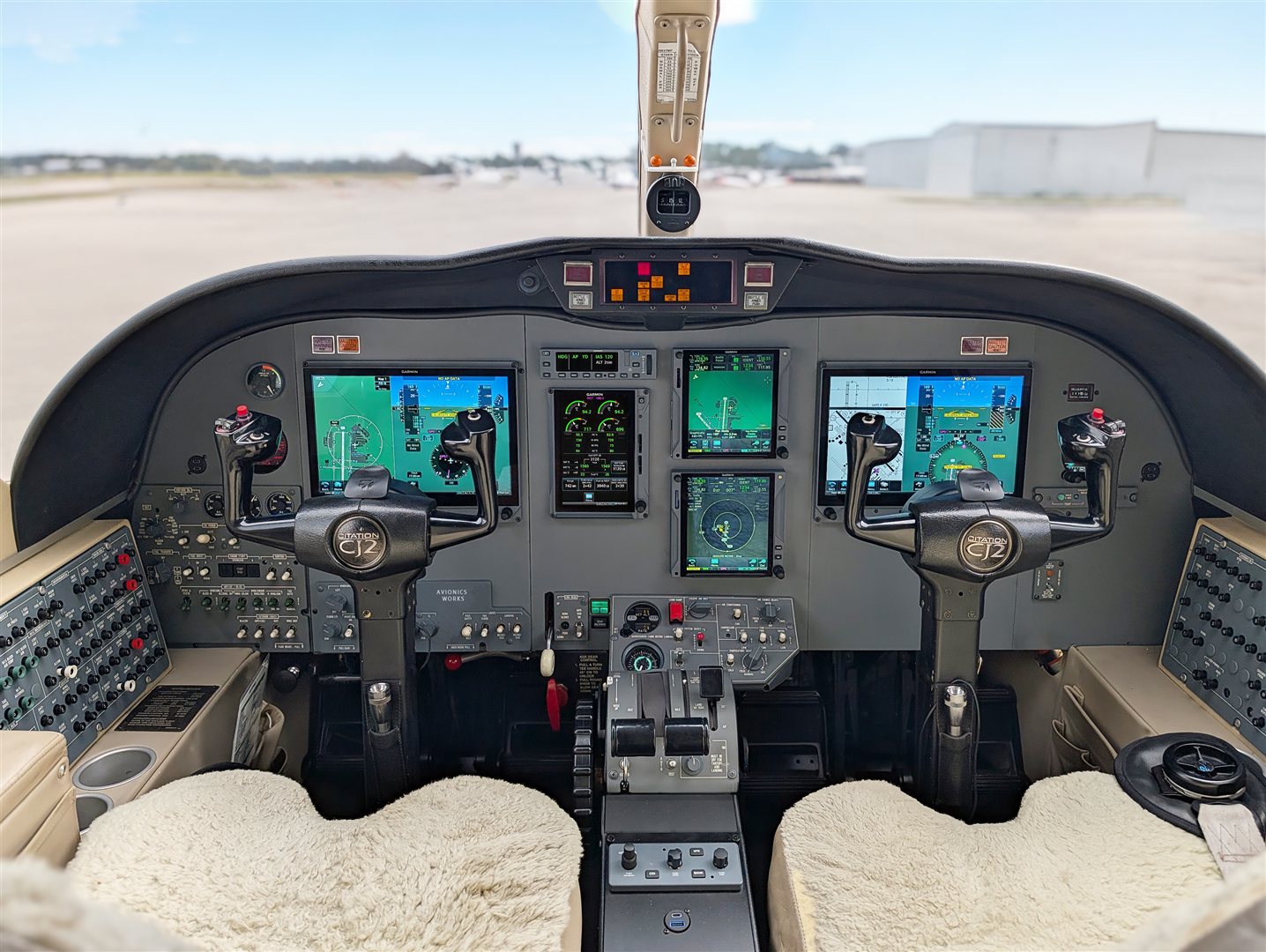
Our completed Citation builds are flying today with full Garmin glass cockpits: dual G600 TXi flight displays, GTN 750Xi and GTN 650Xi navigators, GFC 600 digital autopilot with Emergency Descent Mode, TXi EIS with automatic N1 target computation, GWX 8000 StormOptix weather radar, GI 275 standby instruments, and a GMA 35 audio panel. Every system integrated, tested, and delivering exactly what the owners expected.
M2/CJ1 Glass Cockpit — Before & After
From Legacy CRT to Full Garmin Glass
Citation 525 jets come to us with its original Collins Pro Line 21 avionics — aging CRT displays, a dated FMS, and an autopilot that was becoming increasingly expensive to maintain. Parts availability for the legacy system was shrinking, and the owner wanted a cockpit that matched the capability of the airframe.
We stripped the panel down to bare metal. Every legacy wire harness was documented, removed, and replaced with custom-fabricated Garmin-specification harnesses. The instrument panel was redesigned from scratch — CNC-cut from aircraft-grade aluminum to accommodate the G600 TXi display bezels, GTN Xi navigator trays, and the new TXi EIS display.
The result is a cockpit that looks and performs like it came from the Cessna factory floor — except with technology that’s decades ahead of the original equipment.
View Full Gallery →What’s Included in the M2/CJ1 Garmin Upgrade
Every component selected and configured specifically for the Citation 525 platform — not a generic parts list, but a proven integration package we’ve installed and validated.
Garmin G600 TXi Flight Displays
Dual 10.6-inch touchscreen displays replace the aging Collins CRT PFD and MFD. In the M2/CJ1 installation, we configured these with the Citation 525-specific software load that includes stabilized approach cues, audible V-speed callouts for single-pilot operations, and split-screen PFD/MFD views.
- Touchscreen PFD with synthetic vision (SVT)
- Split 60/40 PFD/MFD configurable per pilot
- Integrated NEXRAD, ADS-B traffic, terrain overlay
- M2-specific V-speed callouts & approach cues
- Georeferenced charts and SafeTaxi diagrams
Garmin GTN 750Xi & GTN 650Xi Navigators
The navigator stack replaces the Collins FMS with WAAS/SBAS-capable GPS that enables LPV approaches down to 200-foot minimums. We install the GTN 750Xi as the primary unit and GTN 650Xi as secondary — giving you redundant navigation with full approach capability from either unit.
- WAAS/SBAS LPV approaches to 200’ minimums
- Coupled VNAV descents via GFC 600 integration
- Graphical flight planning with SID/STAR overlays
- Wireless flight plan loading via Connext
- Radar returns displayed on GTN 750Xi
Garmin TXi EIS Engine Indication
The TXi EIS replaces the legacy engine indication system with a dedicated touchscreen display specifically calibrated for the Williams FJ44-1AP turbofan engines in the M2/CJ1. This is one of the most impactful upgrades — no more manual N1 calculations during takeoff.
- Automatic N1 targets for takeoff, go-around, max continuous
- Accounts for anti-ice status and OAT automatically
- Integrated start timers for engine limitation compliance
- Pilot-defined N1 reference bugs
- Clean, refined gauge layout vs. legacy round gauges
Garmin GFC 600 Digital Autopilot
The GFC 600 replaces the legacy Collins autopilot with a modern digital system that adds capabilities the original never had. The M2/CJ1 installation is particularly involved — the servo mounting locations, control cable routing, and integration with the existing trim system all require careful engineering.
- VNAV descents coupled with GTN Xi flight planning
- Fully coupled go-around capability
- Emergency Descent Mode (EDM) for pressurization loss
- Electronic Stability Protection (ESP) — M2 specific
- Flight Level Change (FLC) mode
- Modernized mode controller with color display
Garmin GWX 8000 StormOptix Radar
The GWX 8000 replaces the legacy radar with Garmin’s latest auto-mode weather radar. In our installation, we routed the radome connections and antenna cabling to integrate seamlessly with both the G600 TXi displays and the GTN 750Xi for pilot-independent radar views.
- Automatic tilt and gain — no manual scanning required
- StormOptix cell identification and hail prediction
- Turbulence detection with zero blind range
- High-definition color palette (4x standard detail)
- Dual display — independent views on TXi and GTN 750Xi
Standby, Audio & Integration
A full conversion isn’t just the headline boxes — it’s the supporting systems that tie everything together. These components complete the cockpit and ensure full redundancy and integration.
- GI 275 standby instruments (attitude + airspeed/altitude)
- GMA 35 digital audio panel
- GTX 345 ADS-B Out/In transponder
- Flight Stream 510 for wireless connectivity
- Custom CNC-cut instrument panel (aircraft-grade aluminum)
- Complete wiring harness fabrication
Citation 525 Family Specialists
Anyone can list a Citation Garmin upgrade on their website. Here’s why owners trust us to actually do it.
Proven Citation Build
We haven’t just read the STC supplement — we’ve completed multiple Citation Garmin conversions. Our builds are flying today, validated by real-world flight hours. When you walk into our shop, we can show you the panels we’ve fabricated, the wiring we’ve routed, and the integration challenges we’ve solved.
FAA Certified Repair Station
We operate under FAA Repair Station Certificate #1VWR276D. This isn’t a field approval operation — it’s a fully certified facility with documented quality systems, trained inspectors, and the regulatory authority to perform major avionics alterations on turbine aircraft.
Custom Panel Fabrication
Every Citation panel we build is designed from scratch in CAD and CNC-cut in-house from aircraft-grade aluminum. We don’t use adapter plates or third-party overlays. The panel is designed specifically for your aircraft’s configuration, with precision cutouts for every display, navigator, and switch.
Florida Location
Based in Sebastian, Florida — right in the middle of one of the country’s densest general aviation corridors. Easy access for M2/CJ1 owners across the Southeast, Caribbean, and East Coast. No mountain passes or weather delays — fly in, drop the airplane, and we’ll take it from there.
Citation 525 Expertise
The Citation 525 family has specific challenges other shops may not be prepared for: tight wire bundle routing behind the panel, integration between the Garmin systems and the Williams FJ44 engine interfaces, autopilot servo installation in the M2’s flight control system, and legacy relay management. We’ve solved all of them.
Direct Communication
You talk directly to the technicians working on your aircraft — not a sales department. We provide weekly photo updates during the build, and you’re welcome to visit the shop at any point during the project. No surprises, no ghosting, no corporate runaround.
The M2/CJ1 Upgrade Process
Consultation & Planning
We review your aircraft’s current configuration, discuss your mission requirements, and develop a detailed scope of work with line-item pricing. No vague estimates — you’ll know exactly what you’re getting.
Panel Design & Fabrication
While your aircraft is still in service, we design the new panel in CAD, review it with you, and CNC-cut it in-house. Wiring harnesses are pre-fabricated to reduce downtime once the aircraft arrives.
Legacy Removal & Installation
The aircraft comes to our shop. We strip the legacy avionics, document everything, install the new Garmin suite, route all new wiring harnesses, and mount the custom panel.
Testing & Delivery
Comprehensive ground testing, system integration verification, ground runs, and flight testing. We don’t release the aircraft until every system is performing exactly as specified. Full documentation provided.
M2/CJ1 Garmin Upgrade FAQ
Real answers from a shop that’s done multiple builds — not generic FAQ filler.
A complete Citation 525-family Garmin glass cockpit conversion typically takes 3 to 4 weeks from the time the aircraft enters the shop. We pre-fabricate your custom panel and wiring harnesses before the aircraft arrives, so when it rolls into the shop, we hit the ground running.
The timeline can vary depending on parts availability from Garmin, the condition of your existing wiring (some Citation 525s have had previous modifications that complicate removal), and whether you’re combining the avionics work with other maintenance like paint or interior. We provide a detailed project timeline before starting so you can plan accordingly.
A full Citation M2/CJ1 Garmin glass cockpit conversion — including dual G600 TXi displays, GTN 750Xi and GTN 650Xi navigators, GFC 600 autopilot, TXi EIS, GWX 8000 weather radar, GI 275 standby instruments, GMA 35 audio panel, and all installation labor — depends on your specific configuration, the condition of existing wiring, and which optional additions you choose.
Every Citation 525 is different, so we provide detailed line-item quotes tailored to your aircraft — no vague “starting at” pricing. We’ll walk you through exactly what’s included and why. Contact us for a custom quote based on your specific aircraft.
Technically yes, but we generally recommend doing the full conversion at once — and here’s why. The Garmin system is deeply integrated: the G600 TXi displays, GFC 600 autopilot, GTN Xi navigators, and TXi EIS all communicate through a shared high-speed data bus. Breaking the upgrade into phases means returning the aircraft multiple times, which adds significant labor cost for repeated panel removal, wiring reconnection, and re-integration testing each visit.
That said, some owners choose to phase in the weather radar (GWX 8000) or datalink weather components separately, since those are more modular and don’t require pulling the entire panel again. We’ll help you evaluate the most practical phasing strategy if budget timing is a factor — but in most cases, doing it all at once saves money and downtime.
Yes, significantly. An M2 or CJ1 with a full Garmin glass cockpit commands a significant premium on the resale market compared to an equivalent airframe with original Collins Pro Line 21 avionics. The market consistently rewards modernized glass cockpits.
The original Collins avionics in older CJ1s are aging rapidly. Parts are becoming harder to source, repair turnaround times are increasing, and maintenance costs are climbing. Buyers know this. A Garmin-equipped M2 is more attractive for both personal owners and Part 135 charter operators, and it effectively extends the aircraft’s economic lifespan by decades. The upgrade often pays for a significant portion of itself at resale.
In a complete conversion, essentially the entire flight deck is replaced:
Collins Pro Line 21 PFD/MFD → Garmin G600 TXi touchscreen displays
Collins FMS & GPS → Garmin GTN 750Xi + GTN 650Xi navigators
Collins autopilot → Garmin GFC 600 digital autopilot
Legacy engine instruments → Garmin TXi EIS
Original weather radar → Garmin GWX 8000 StormOptix
Legacy standby instruments → Garmin GI 275 electronic standby
Original audio panel → Garmin GMA 35
Additionally, all associated wiring harnesses are custom fabricated to Garmin specifications, and the instrument panel itself is redesigned and CNC-cut to accommodate the new equipment. The only things that typically remain from the original avionics installation are the antenna locations (though antennas themselves may be upgraded) and basic airframe infrastructure.
Yes, plan for approximately 4 weeks of downtime. We pre-fabricate the panel and wiring harnesses before your aircraft arrives, so when it rolls into the shop we hit the ground running. This significantly reduces the time your aircraft is out of service compared to shops that do all fabrication with the aircraft on-site.
Here’s how we help minimize the impact:
Combine with other downtime: Many owners schedule the avionics upgrade during annual inspection, paint, or interior refurbishment to maximize productivity.
Pre-fabrication: Panel and wiring harnesses are designed, built, and tested before the aircraft arrives.
Temporary aircraft: We can help coordinate with charter companies or rental providers if you need a temporary replacement during the project.
The most important difference: we’ve completed multiple Citation glass cockpit conversions. These aren’t theoretical capabilities or marketing pages — they’re real airplanes flying today with the full Garmin suite we installed.
Our team has hands-on experience with the specific challenges of the Citation 525 platform: tight wire routing behind the Citation 525 panel, the custom panel fabrication required for Garmin display cutouts, the integration between the TXi EIS and the Williams FJ44-1AP engines, and the autopilot servo installation in the M2’s flight control system.
We’re also an FAA Certified Repair Station (CRS #1VWR276D) — not a field approval shop — which means our work meets the highest regulatory standards for major avionics alterations. And we’re located in Sebastian, Florida, one of the busiest GA corridors in the country, making us easily accessible for M2/CJ1 owners across the Southeast and East Coast.
Let’s Plan Your M2/CJ1 Garmin Conversion
Whether you’re ready to commit or just exploring options, we’ll give you a straight answer on timeline and what to expect. No sales pressure — just real information from a team that’s done multiple builds.
Aircraft Avionics Works LLC · FAA CRS #1VWR276D · 214 Airport Dr E, Sebastian, FL 32958